Tracy blackmailed Willow, forcing her to make her husband a vegetable General Hospital Spoilers
ABC General Hospital spoilers reveal that in the aftermath of Drew’s sudden coma, one of the most striking new adjustments in the storyline is a quiet but unmistakable shift of power toward Tracy.
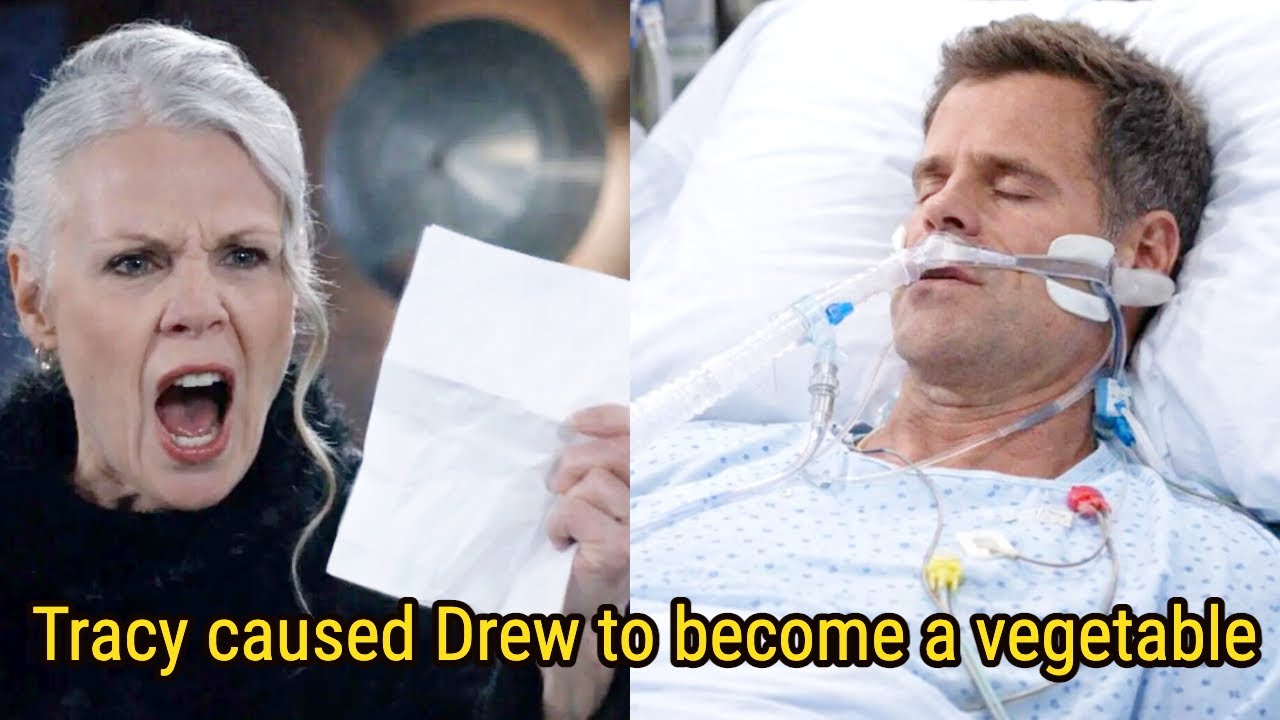
No longer content to stand on the sidelines as a sharp-tongued observer, Tracy actively moves to take control of the situation.
With Drew incapacitated and unable to speak for himself, Tracy recognizes a rare opening—one where decisions can be redirected, narratives reframed, and consequences reshaped before anyone else fully understands what is happening.
Her actions are not loud or impulsive.
They are calculated, precise, and deeply unsettling.




Rather than compassion, Tracy appears focused on restoring an order that serves her own version of justice.
This adjustment signals a significant change in the direction of the story.
No longer is the narrative centered solely on who harmed Drew, but on who will define the meaning of his silence.
Tracy’s maneuvering reframes the coma from a medical crisis into a strategic turning point—one where power shifts hands behind closed doors and moral lines begin to blur.
By stepping in to “stabilize” the fallout, she effectively controls the flow of information, the emotional temperature of those around her, and even the future consequences Drew may face if he ever wakes.
This evolution confirms that the narrative has entered a darker, more political phase—
one where control matters more than truth, and where Drew’s condition is not just tragic, but dangerously useful.
Tracy’s willingness to make decisive moves in the wake of Drew’s coma marks a disturbing recalibration of control within the story.
One that suggests her intentions may run far deeper than cruelty or bitter satisfaction.
Her open desire for Drew to remain a permanent vegetable is not merely an emotional reaction, but a strategic position—one that creates space for irreversible outcomes while allowing her to maintain plausible deniability.
This fuels a chilling theory: that Tracy may have been the hidden hand behind the poison itself, supplying Willow with the drug that pushed Drew over the edge while carefully insulating herself from direct blame.
What makes this possibility especially unsettling is Tracy’s deep-rooted influence within the hospital.
Her long-standing relationships grant her quiet access to systems, people, and moments where oversight can be bent—or erased.
Through that network, a second attack on Drew would require no violence or spectacle.
Only timing. Pressure. And silence.
Whether the goal is to lock Drew into a vegetative state or ensure that he never wakes at all, the storyline now pulses with a new obsession—the fear that Drew’s body has become a battleground for power rather than a patient in need of saving.
This evolving arc transforms Tracy from a cynical commentator into a potential architect of destruction.
The danger is no longer over—it has simply changed form, becoming colder, more deliberate, and far more terrifying.
The emerging adjustment reveals Tracy’s deeper ambition: to reclaim absolute control over the Quartermaine core, using Drew’s condition as both leverage and justification.
With Drew silenced and vulnerable, Tracy sees an opportunity not just to influence outcomes, but to rewrite the balance of power that once slipped from her grasp.
Her fixation on reclaiming authority, legacy, and material advantage tied to Drew evolves into a new obsession—one that pushes her beyond manipulation and into far more dangerous territory.
This shift reframes Tracy’s motivations as strategic rather than emotional.
Every move appears designed to tighten her grip on the family while positioning herself as the only figure strong enough to impose order amid chaos.
As control becomes inseparable from domination, concern for Drew’s survival fades behind the urgency of securing long-term advantage.
What makes this adjustment so compelling—and so unsettling—is the sense that Tracy is no longer reacting to events, but actively engineering them.
She is widening her influence, testing how far she can push before resistance forms.
And in doing so, the story enters a darker phase—one where family loyalty erodes under pressure, and Tracy’s need for control becomes the central force driving the conflict forward.