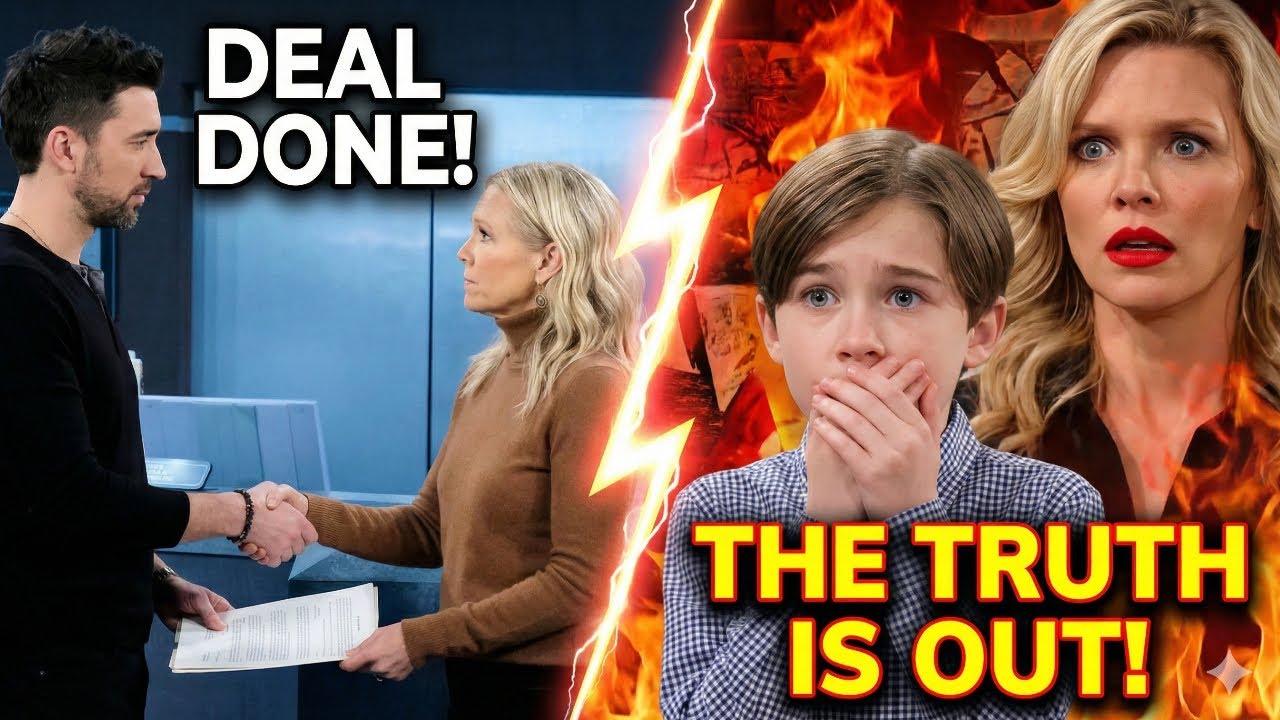
Days of Our Lives: Chad & Jen FINALLY Reach a Deal! Thomas & Cat BLINDSIDED by the Truth!
Chad’s Impossible Promise: When Thomas Breaks Down and the Custody War “Ends” — Or Does It?
Days of Our Lives Deep Dive
At first glance, the headlines suggest resolution.
A custody agreement is reached. Mediation appears successful. Calm, at last, descends over the bitter battle between Chad DiMera, Jennifer Horton, and Jack Deveraux.
But in Salem, legal closure rarely signals emotional peace. More often, it marks the beginning of a deeper fracture.
As next week’s spoilers unfold, it becomes painfully clear that this storyline is not about paperwork or visitation schedules. It is about grief, generational trauma, and a child quietly absorbing the emotional wreckage of the adults meant to protect him.




At the center of it all stands Thomas DiMera—a little boy carrying far more than any child should.
Jennifer Horton’s Interrogation: Grief Disguised as Control
Spoilers indicate that Jennifer will “question” Chad next week.
The word is polite. The reality will not be.
This will not be a casual conversation between co-parents. It is an interrogation born of unresolved grief. Jennifer has lost Abigail—the wound is permanent. Thomas and Charlotte are not just grandchildren to her; they are living extensions of the daughter she can no longer protect.
When Jennifer looks at Chad, she does not simply see a grieving widower. She sees instability. She sees impulsive romantic choices. She sees history repeating itself.
Most crucially, she sees echoes of Jack Deveraux’s past—years marked by absence, chaos, and emotional unpredictability that once deeply affected Abigail herself.
When Jennifer asks Chad what steps he is taking to convince Thomas that he is trustworthy, she is asking something far more pointed:
Can you put your son’s emotional safety above your own desires?
Chad’s problem is not a lack of love. It is a lack of certainty. He reacts. He reassures. He promises. But he does not demonstrate a concrete plan—and Jennifer senses it immediately.
An agreement built on hesitation is already compromised.
The Cat Greene Variable: A Promise Doomed to Fail
Despite the custody deal, Thomas remains terrified. The reason is simple: Cat Greene.
Spoilers confirm that Chad promises to stay away from her. He likely means it—at least in the moment. But intention and execution are not the same thing, especially where Chad DiMera is concerned.
This is a man who becomes obsessive when emotionally attached. History supports it. Soap logic guarantees it.
Thomas’s fear is not merely jealousy or grief. Children are intuitive. Thomas senses that Cat represents a shift—not just in Chad’s romantic life, but in the emotional structure of his family. To him, Cat symbolizes impermanence, instability, and the erasure of his mother’s place in the home.
Chad’s promise, then, is not reassurance. It is a fragile bandage over a deep wound.
Jennifer understands this. She presses Chad not whether he will stay away—but how. Blocking a number? Changing routines? Setting boundaries? Chad offers words, not safeguards.
And in Salem, words are rarely enough.
The setup is clear: Chad will be forced into contact with Cat—by chance, crisis, or necessity. Thomas will see it. And when a child catches a parent in a lie, something fundamental breaks.
Hero becomes human. Trust becomes conditional.
Thomas’s Confession: The Weight of Misplaced Guilt
Perhaps the most devastating spoiler is Thomas’s confession—to Jeremy Horton.
Thomas believes the fighting is his fault.
This is textbook childhood trauma. Children do not understand custody law. They understand emotion. Raised voices. Tears. Tension. And because children are naturally egocentric, they internalize blame.
If I hadn’t spoken up…
If I wasn’t sad…
If I didn’t exist…
This is how generational damage begins.
Salem has told this story before. EJ DiMera. Chad himself. Children raised in emotional war zones do not grow into peaceful adults.
Thomas stands at that threshold now.
Jeremy Horton: An Unexpected Anchor
That Thomas confides in Jeremy is no accident.
Jeremy exists outside the immediate parental conflict. He is not a disciplinarian or authority figure. He is safe. Neutral. Familiar.
Spoilers indicate Jeremy reassures Thomas—an act that may quietly redefine his role in this story. For perhaps the first time, Jeremy is positioned not as chaos or complication, but as conscience.
This moment could change everything.
Jeremy may become the bridge between generations—the voice that forces Chad, Jack, and Jennifer to confront an uncomfortable truth:
They are not protecting Thomas.
They are harming him.
While the show could twist this into manipulation, all signs point toward sincerity. And Salem desperately needs a character willing to say, “Stop. This child is breaking.”
The Agreement: A Legal Peace, an Emotional Time Bomb
The custody agreement itself feels less like resolution and more like a loaded weapon.
Shared custody invites constant friction. Conditional custody invites inevitable violation. And a morality clause—particularly one barring Cat Greene—would be Jennifer’s ultimate safeguard.
If Chad signs such a clause, he does so under emotional duress. And the moment he violates it, Jennifer will not hesitate to act.
This is Chekhov’s gun in legal form.
History supports the pattern. Salem custody battles always end with one catastrophic misstep. Chad is currently the one under scrutiny—and DiMeras, when cornered, rarely respond gently.
Chad is calm now. Cooperative. But if he feels trapped or threatened, the DiMera instinct to reclaim power may resurface.
And when that happens, no agreement will survive.
Conclusion: The Storm Beneath the Silence
Next week’s episodes are not about action or spectacle. They are about emotional erosion.
Jennifer seeks certainty in a world that no longer offers it.
Chad makes promises he cannot guarantee.
Jeremy emerges as an unlikely emotional anchor.
And Thomas—tragically—believes adult failures belong to him.
The dialogue may insist “We have an agreement.”
But the subtext tells a far darker story.
In Salem, peace is rarely permanent.
And when children begin blaming themselves, the real damage has already begun.
The custody war may appear over. But the emotional fallout is just beginning.