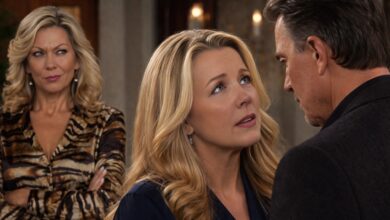
PHYLLIS CHOSE POWER OVER HER OWN CHILDREN… AND THIS MAY BE THE MOMENT SHE BECAME UNSTOPPABLE
This wasn’t the moment Phyllis lost everything. It was the moment she decided she didn’t need anyone anymore. What unfolded in the March 31 episode of The Young and the Restless wasn’t just a family breakdown—it was a character shift that may redefine Phyllis forever. For years, she has been chaotic, impulsive, and fiercely protective of her children. But this time, something changed. Faced with an impossible choice, she didn’t fight to hold her family together. She let them go.

The turning point came through two devastating blows that hit back-to-back. Summer’s letter wasn’t just emotional—it was final. There was no room for negotiation, no hint of reconciliation. It was cold, distant, and absolute. Then came Daniel’s ultimatum, drawing a clear line in the sand: return the company or lose your family for good. This wasn’t about misunderstanding or hurt feelings anymore. This was a forced decision. And in that moment, Phyllis didn’t hesitate as much as fans expected. She didn’t chase after Daniel. She didn’t crumble publicly. She stood her ground.
That’s where everything shifts. Phyllis has always justified her actions as being for her children, for their future, for their protection. But now, that justification no longer holds. When both Summer and Daniel rejected her, she had one last chance to step back, to undo the damage, to choose them. Instead, she chose power. Not because she didn’t feel the pain, but because she accepted the cost. That’s the difference. This isn’t denial. It’s acceptance.

Her line about Victor, Jack, and Cane reveals just how self-aware she truly is. She understands the rules of this world. She knows that powerful men have made the same moves she just did—and gotten away with it. Her frustration isn’t confusion. It’s defiance. She refuses to be judged by a different standard. And that mindset is what makes this moment so dangerous. Because villains in this world aren’t created by ignorance. They’re created by people who know exactly what they’re doing and choose to do it anyway.
What makes this shift even more powerful is that Phyllis is now completely unanchored. Summer is gone. Daniel is walking away. Jack is distant and consumed by his own problems. There is no emotional safety net left. And in soap storytelling, that kind of isolation doesn’t weaken a character—it transforms them. Without anything tying her back, Phyllis is free to become something else entirely. Someone sharper, colder, and far more strategic.




There’s also a deeper, almost ironic layer to all of this. Phyllis has spent years clashing with Victor, criticizing his ruthless methods and the way he prioritizes control over relationships. But now, she’s stepping into that exact role. Choosing power over family. Refusing to apologize. Standing firm even when it costs her everything. This isn’t just a downfall—it’s an evolution into the very kind of player she once opposed. And that parallel is exactly what makes this storyline so compelling.
Looking ahead, the most likely path isn’t redemption—it’s escalation. If Phyllis gives up the company now, then losing Summer and Daniel becomes meaningless. The emotional cost would have no payoff. But if she holds on, if she doubles down, then every broken relationship fuels her rise. Fans are already speculating that this could lead to a full-scale power war, with Phyllis carving out her own empire and refusing to bow to the Newmans or anyone else.
And yet, what keeps this from becoming a one-note villain story is the emotional undercurrent. Phyllis isn’t numb. She’s hurting. The devastation from Summer’s letter is real. Daniel’s rejection cuts deep. But instead of letting that pain break her, she’s using it to rebuild herself in a different image. That’s what makes this so gripping. It’s not about losing humanity—it’s about choosing strength over vulnerability, even when it comes at a devastating cost.
In the end, this isn’t the story of a woman who fell apart. It’s the story of a woman who made a choice—and is willing to live with the consequences. Phyllis didn’t break under pressure. She redefined herself because of it. And if this really is the beginning of her villain era, then the most dangerous part isn’t what she’s lost. It’s what she’s become without it.